
Hartford Resident Records Coverage
There is no single Hartford name file that proves a person’s identity, address, and history. A good resident lookup joins sources that were created for different reasons. The assessor records an assessed owner and parcel. The voter system records registration information with privacy controls. The Judicial Branch displays public party and docket information. Probate connects estates and heirs. Vital forms certify events under separate eligibility rules. Directories and obituaries can bridge older years.
| Record | What it can confirm | Where | Access |
|---|---|---|---|
| Assessor parcel / CAMA | Assessed owner, situs, mailing, property fields | Hartford Property Viewer | Public map and REST |
| Voter registration | Named status, district, polling route, public history indicator | Connecticut SOTS / Hartford ROV | Lookup and office |
| Judicial party search | Name variant, docket, court, filing, last action, disposition | Connecticut Judicial Branch | Public display with limits |
| Probate | Decedent, fiduciary, heir, attorney, case status | Hartford Probate PD-01 | Lookup; documents restricted |
| Vital records | Birth, death, marriage, event and family facts | Hartford / Connecticut DPH | Forms, ID, eligibility, fee |
| Directories and obituaries | Dated address, occupation, household, death or kinship lead | HPL, CSL, CHS, FamilySearch | Reference, scan, microfilm |
Choose the first source from the clue in hand. A parcel or street is more useful than a name alone for property research. A docket or case number is better than a broad name search. A family-history question may begin with a directory or obituary and only later reach a vital or probate custodian.
Hartford Name Search: One Anchor
Same-name collisions are common in a city with a long directory and court history. Record the exact spelling, initials, known street or neighborhood, approximate age or year, occupation, spouse or parent, and the reason for the search. Those details are not all public search fields, but they help decide whether two records can belong to the same person.
Use two independent anchors before joining records. A parcel owner plus a mailing city is one pair. A directory name plus occupation and street is another. A court party plus Hartford location and docket date is stronger than a name-only result. Keep roles separate: owner, grantee, fiduciary, attorney, voter, licensee, registered agent, directory occupant, and household member do not mean the same thing.
When the purpose becomes street-based rather than person-based, move to the Hartford by-street records workflow. A person search should not grow into an unsupported roster of everyone near an address.
Hartford Resident Records: Property Owner
The Hartford Property Information Viewer accepts an owner-name search as well as an address or parcel search. Save the parcel number, owner field, situs, mailing address, LegalRef, TaxMap, and LastSaleDate. A name match in the owner field is a property connection. It is not proof of current residence. A trust, estate, LLC, fiduciary, or absentee owner can appear there.
Compare the mailing address with the physical situs. A mailing field may point to another street, city, state, PO box, or agent. Follow LastGrantor and LegalRef into SearchIQS when the person’s property history matters. Use the same-name and date checks before connecting a deed party to a court, directory, or voter record.
Assessment records have their own time frame. Hartford cites October 1 as the assessment date, a 2021 revaluation, and a next scheduled revaluation in 2026. A card can lag a transfer or a change in use, so note the source date and confirm with the Assessor when the result is central to the question.
Hartford Voter Registration Records
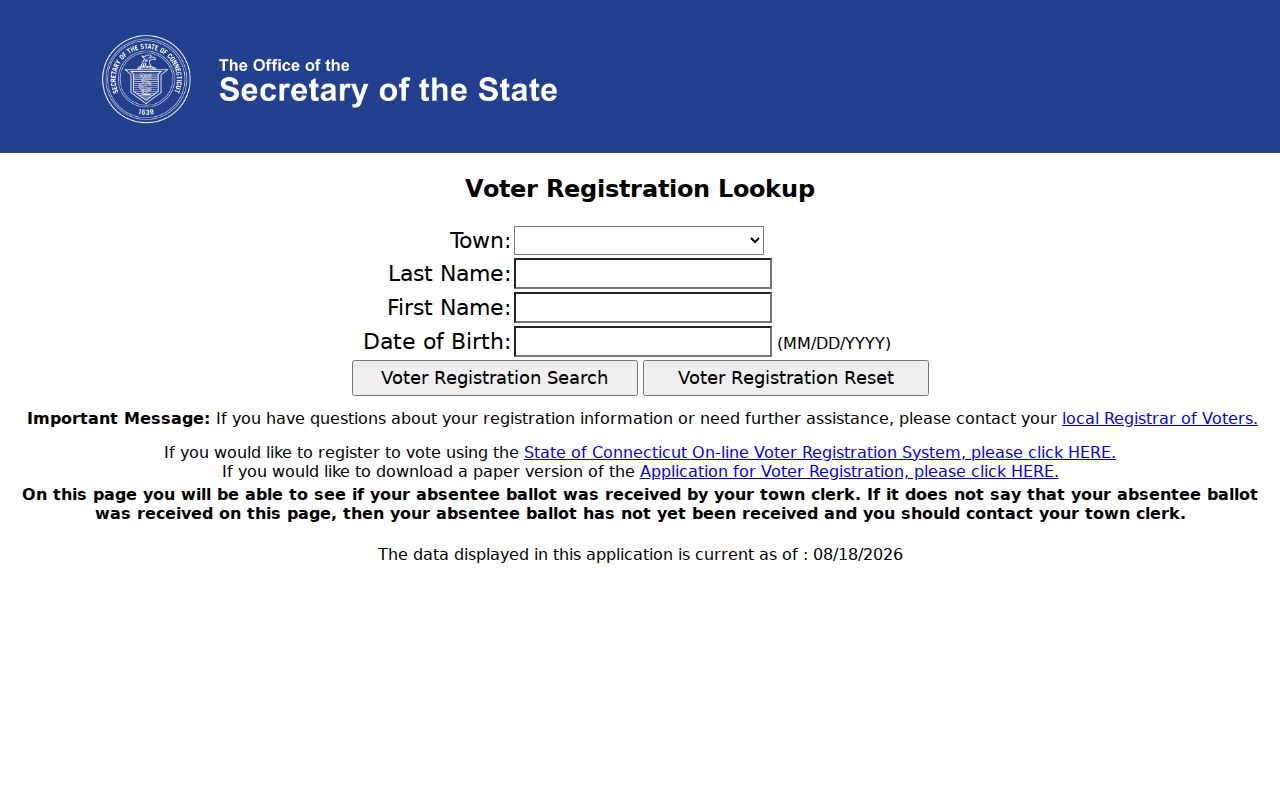
The Connecticut voter lookup is designed for a named registration and polling question. Hartford registrars handle local canvass, correction, district, and polling issues. The live state form was blocked by an anti-bot control during inspection, so exact field labels should be checked at the official route. Do not fill the gap with an invented result format.
Current SOTS guidance says the public release includes only the year of birth, not the month and day, under Public Act 26-1, §96. Registry information may include current or former name and address, district, party affiliation, status, polling place, and participation indicators. Full DOB, driver-license number, full Social Security number, ballot choice, and protected addresses are not ordinary public fields.
Hartford’s registrars can help with an update or correction, but staff should not be asked to disclose protected details. A missing name may reflect the Voter Registry Privacy Program, the Address Confidentiality Program, an inactive record, or a maintenance issue. It is not proof that the person never registered or lived in Hartford.
The official voter screenshot shows the correct state route. Open the Secretary of the State lookup when the question is registration or polling.
The 2026 TotalVote GIS upgrade also shows why an address-to-district result should be dated. Testing found records needing district updates and small sliver districts as geographic precision improved.
Hartford Resident Records in Court
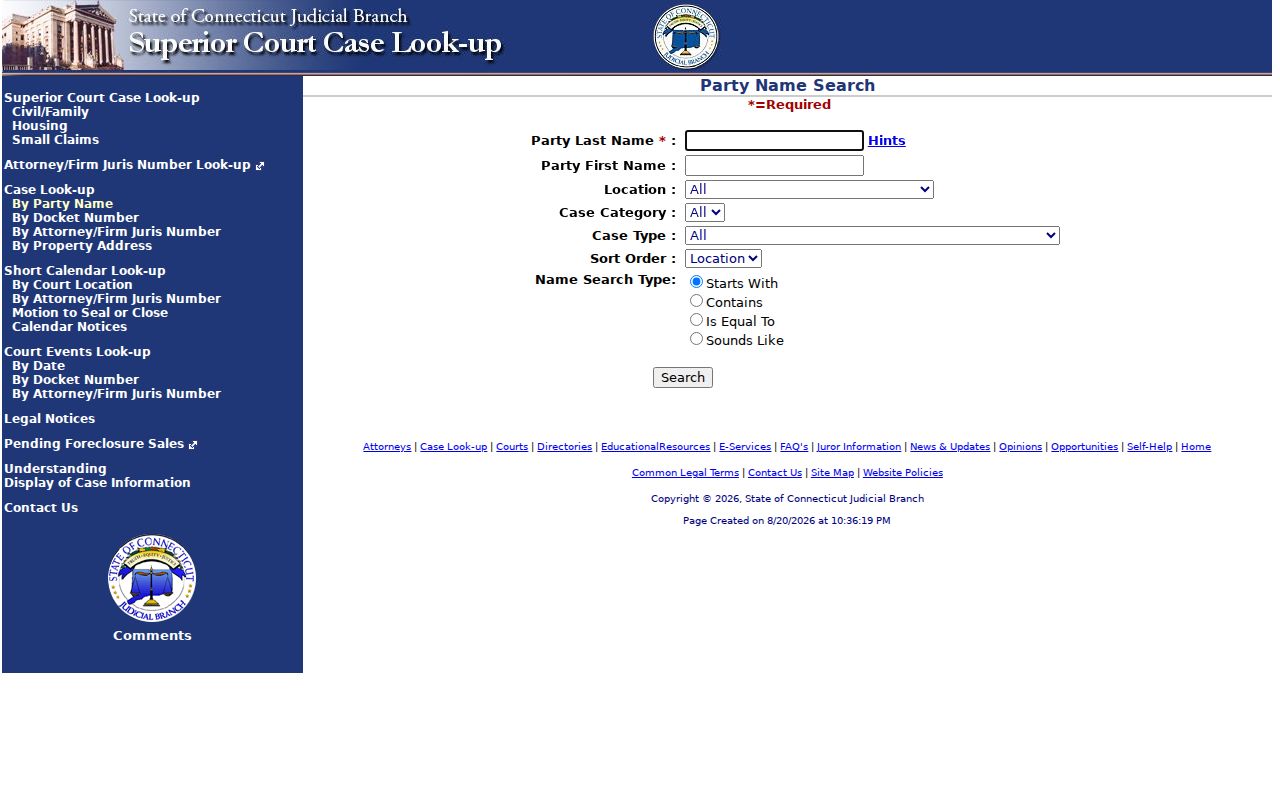
Connecticut’s Judicial Branch party search includes Hartford Judicial District code HHD and the Hartford session code HFH. The by-party-name form asks for a required last name, optional first name, location, case category, case type, sort order, and a name-search mode such as Starts With, Contains, Is Equal To, or Sounds Like. Search variants separately when an apostrophe, initial, or spelling change matters.
Public result displays can show a case name, case type, docket number, file date, return date, court location, last action, list type, party name and role, attorney, entry number, disposition, disposition date, and judge or magistrate. A docket number combines court code, case type, year, and seven digits. Some self-represented address or phone fields can appear, but the display is not the official file.
Cases can be sealed, protected, erased, juvenile, family-confidential, or outside the display period. Older documents may require a courthouse public-access terminal or clerk request. A court result can identify a proceeding; it does not prove current residence, guilt, or identity without another anchor.
| Displayed field | What it contributes |
|---|---|
| Case name and type | Identifies the proceeding category and the names shown by the public display. |
| Docket number and dates | Joins the court code, case type, year, file date, return date, and later entries. |
| Location and party role | Separates Hartford court location from a person’s residence and distinguishes party, attorney, or other role. |
| Last action or disposition | Shows the latest visible case event; it is not a complete file or finding of guilt. |
| Entry number and judicial officer | Provides a clerk-facing reference for follow-up with the courthouse or public-access terminal. |
The inspected party form makes the location filter visible. Search the Connecticut Judicial Branch party index and verify the docket or disposition with the clerk.
Keep a court match in a research ledger with the searched name, location, docket, date, party role, and visibility limit.
Hartford Probate Name Search
Hartford Probate District PD-01 is a better route than a general name search when the person is a decedent, heir, fiduciary, or attorney. The public lookup covers decedent estate and trust data from January 5, 2011 forward. It offers Case Type, District, Status, Last Name, and First Name fields. Historic probate jurisdiction changed over time, so a Hartford District record may concern a place that is not within today’s city boundary.
Probate results may provide a case status and names linked to an estate. The actual papers are controlled separately. Interested parties or self-represented users may need an eFiling access code. Closed nonconfidential material may be available through a public computer or paper file, while confidential or sealed records remain closed.
Use the Connecticut Probate case lookup, then contact the Hartford Probate clerk at 860-757-9150 for access questions. An heir connection should be checked against a death record, obituary, deed, or other independent source.
Hartford Resident Records: Vital Forms
Vital records can verify an event, but a certificate request is not a free name search. Hartford’s local registrar handles Hartford events, while DPH State Vital Records provides the statewide route. Birth records under 100 years have limited eligible requester classes. Records at least 100 years old have a broader genealogical framework. Death certificates are generally available to adults, with Social Security details restricted for deaths after July 1, 1997. Marriage certificates are generally available to adults, with spouse Social Security numbers protected.
The captured town and state forms ask for the subject’s full name, date and place of event, parent or spouse details, requester address, relationship, reason, signature, copies, ID, and payment. Town birth copies list $20 full-size and $15 wallet choices; state birth copies list $30 each. Death and marriage forms generally list $20 per certified copy. Payment type, mail address, and eligibility belong to the current form.
Use a certified copy when the purpose needs one. For genealogy, a directory, obituary, cemetery register, church record, census, or HPL/State Library collection may supply a lead without exposing a modern restricted record. Divorce files are Judicial Branch records, not a generic DPH marriage index.
Hartford License and Business Records
A person can appear in Hartford research through a business entity, local trade name, professional license, permit, or UCC filing. Business.CT.gov supports exact business-name or Business ID searches and broader principal or agent queries. Hartford’s Town and City Clerk handles local trade-name applications, which are not interchangeable with a state entity filing. Connecticut eLicense covers more than 800 license or permit types and can search by license type, prefix, number, status, business or DBA name, first name, last name, city, state, ZIP, and country.
License results can show a credential name, number, type, effective or issue date, expiration, status, address, and scope where applicable. That confirms an affiliation or credential. It does not prove that the licensee lives at the business address. A permit may identify an applicant or licensed professional for a project, not a household member.
Reach the official portal directly. State officials have warned about registry phishing and spoofed filing messages, so a search result should be opened from Business.CT.gov or portal.ct.gov rather than an unsolicited signature link.
Hartford Directory Search: Older Classmate
Older resident research often works better through a library than a current lookup. Hartford Public Library holds or routes researchers to city directories, reverse and telephone directories, newspaper microfilm, obituary material, yearbooks, maps, photos, and Hartford City and Town Clerk archives. The State Library adds census, town documents, cemetery, church, court, and FamilySearch guidance. CHS finding aids can add neighborhood, civic, ethnic, and institutional context.
Start with the yearbook, directory, or school clue. Record the printed name, street, occupation, spouse, organization, and page. Then compare a census year or a newspaper item. The State Library’s Francesco DiCorleto example follows a 1911 Hartford directory entry through marriage or vital records, 1920 and 1930 census schedules, and an obituary. That kind of cross-check is stronger than a modern name-only match.
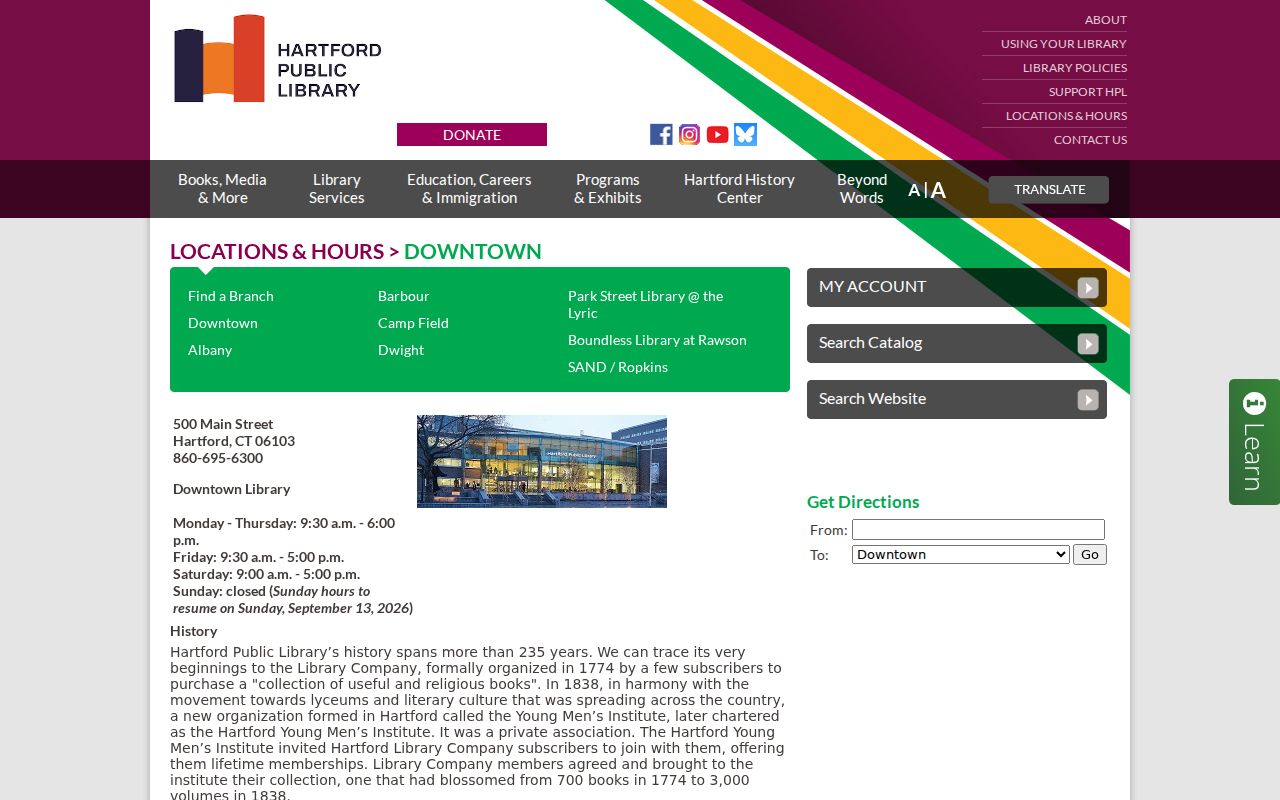
HPL’s local-history access point is shown here. Check Hartford History Center access before requesting a yearbook or microfilm run.
Ask staff whether the collection is on site, digitized, on microfilm, or temporarily off site. A catalog entry and a scan are not the same thing.
The full historical shelf is organized on the Hartford city directories page, including Geer, Gardner, reverse volumes, census pairing, and community-section cautions.
Hartford Resident Records and Birth Parents
Connecticut adoption and birth-parent research has no public-name shortcut in the inspected material. Vital records have eligibility rules, and adoption files are confidential. A family connection should use the Department of Public Health’s current instructions, an authorized intermediary or registry route when available, and the person’s legal access rights. Do not infer a parent-child relationship from a shared address, surname, obituary, or directory line.
For a lawful family-history question, build the least sensitive chain first: an older directory or census entry, a marriage or obituary lead, an eligible vital request, and a custodian-confirmed record. Keep a note of what was not available. A protected or sealed record is a boundary, not an invitation to search for a substitute private database.
Because the current research did not capture a complete Connecticut adoption-registry or intermediary URL, check the current DPH and Judicial Branch routes before making an application. Do not promise access, processing time, or eligibility from a secondary page.
Verify a Hartford Resident Record
A reliable name search ends with a written ledger. The ledger should state the input name and address or year, the official URL, fields used, search date, exact result name, parcel, case, document, or page number, the person’s role, and any visibility or privacy limit. Three independent anchors are a practical minimum for a high-confidence historical identity: a parcel, deed, or voter record; a court, vital, or directory record; and a separate date, address, or relationship check.
- Anchor the name to a Hartford parcel, street, district, directory year, or family relationship.
- Search the appropriate official system and record the result fields, not just a screenshot or name.
- Separate owner, grantee, voter, party, fiduciary, licensee, and directory occupant roles.
- Confirm with a second custodian, such as HPL, the clerk, Assessor, registrar, Probate, DPH, or Judicial Branch.
- Stop when the record is protected, sealed, erased, restricted, or unable to support the claim.
- Docket
- The court’s identifier for a case, not a guarantee that every paper or party detail is public.
- Index versus image
- An index describes a record; an image is the scanned or filed document, and access can differ.
- Certified copy
- A custodian-issued copy with official certification, available only under the record’s eligibility rules.
When the goal changes to the history of one address, use the past-resident trail rather than expanding a one-person search into unrelated names.
Legal Limits on a Hartford Resident Lookup
Connecticut’s Freedom of Information Act opens nonexempt public records, but it does not override birth-record eligibility, Social Security restrictions, sealed or protected court material, adoption confidentiality, the Address Confidentiality Program, or the Voter Registry Privacy Program. The Connecticut Data Privacy Act gives covered consumers rights against covered controllers, while public-record regimes and state-custodian rules still matter. DMV personal information is restricted by the federal DPPA and CGS §14-10.
A public display is not an official finding that a person lives at an address. Correct a property, voter, vital, court, or business record with its own custodian. Hartford Police reports can be redacted or delayed; DOC and registry data have narrow purposes and time-sensitive disclaimers; a court notice is not a finding of guilt or current residence.
Lawful personal use. A Hartford name search is appropriate for family history, reconnecting, estate research, civic verification, and personal safety awareness. Never use a name, address, or record to stalk, harass, threaten, intimidate, or harm anyone.
Good verification is modest. It states what the record says, when it said it, who held it, and what it cannot establish.